Building Data Quality into Daily Practice
It’s late afternoon in Terrace, BC.
A Kitselas Five Tier System (K5T) Employment Coordinator closes the door after a day full of intakes. One participant was recently laid off from seasonal work and is considering retraining in heavy equipment operations. Another is a young parent exploring pre-apprenticeship options. A third needs support updating certifications before starting work on a local project site.
Each intake involves more than completing a form. For K5T, intake means building a relationship, understanding a participant’s specific barriers, developing an action plan to address them, coordinating with employers, and setting realistic, practical next steps.
Intake also means entering information into the Community-Based Reporting (CBR) Tool. Every intake requires demographic information, consent documentation, information on employment status, action entries, and supporting records. The CBR Tool is designed to track progress, support reporting, and provide visibility into outcomes.
But staff at K5T got into this line of work to help people, not do data entry. When data systems are cumbersome and the value of good data aren't clear to staff, data entry can feel secondary.
““Previous to this training, I didn’t fully understand how this data was used and why it is so necessary.””
Over the course of the project, what changed was not simply the tool itself, but how K5T staff understood and used it.

When Systems Fall Out of Alignment
K5T is a Nation-owned employment and training organization overseen by Kitselas Social Economic Development Corporation (KSEDC). Since launching in 2020, it has grown steadily, expanding programs, staff, and participant reach across Northwest BC. The CBR Tool was introduced in 2021 to centralize participant data and support funder reporting.
Over time, however, growth outpaced internal systems. Expectations around data entry were not always clear. As a result, the data no longer reflected the full scope of work being carried out. Leadership had limited visibility into what services were being provided, to whom, and how consistently. Reporting became more reactive and, as a result, time-intensive.
Aligning the System with the Work
Between 2024 and 2025, K5T partnered with the BC First Nations Regional Information Governance Centre (RIGC) to strengthen both the CBR Tool and the processes surrounding it. The partnership created structured time for reflection and redesign — something that is difficult to prioritize amid daily service delivery. Together, the teams reviewed workflows, clarified reporting expectations, and simplified how information is entered and tracked.
Importantly, the focus extended beyond technical fixes. The work recognized that data quality is shaped by routines, expectations, and shared understanding.
K5T introduced dashboards, tracking key metrics, to create shared accountability and visibility and committed to reviewing them weekly. Administrative time was protected. Expectations were aligned with planning and funding requirements. Rather than adding compliance pressure, K5T focused on making the CBR Tool usable and relevant to staff.
What Changed
Improvements were measurable. Usability increased. Completeness and timeliness improved. A large majority (88%) of coordinators reported improvement in the overall experience of using the tool, and the proportion of outdated records declined. More importantly, the tool began to reflect the work as it was actually happening.
Dashboards became part of weekly conversations. Data entry was integrated into service delivery rhythms rather than treated as a separate administrative task.
““The Weekly Task Dashboard is very user-friendly and basically makes it a breeze. Finding the time to complete the data inputs apart from supporting people in person is the most challenging part of CBR.””
Frontline work continues to take priority. But the system now supports that work rather than competing with it.
Governance Requires Usable Information
Kitselas First Nation has recently ratified its treaty, bringing expanded governance responsibilities and heightened accountability expectations.
Nation-led data systems matter in this context. When Nations can collect, steward, and interpret their own data, they strengthen planning, program oversight, and intergovernmental relationships. Without infrastructure that aligns with program processes and priorities, data remain fragmented or shaped by external requirements. When data infrastructure reflects program realities, data become usable for decision-making.
This work is about ensuring information is accurate, complete, and timely enough to support funding requirements, but more importantly, support informed program design and delivery.
Where to Start
For Nations or organizations looking to improve data quality, the first question is to understand whether existing systems are fit for use or whether to explore a new build.
Are the data accurate?
Are the data complete?
Are the data current enough to inform decisions?
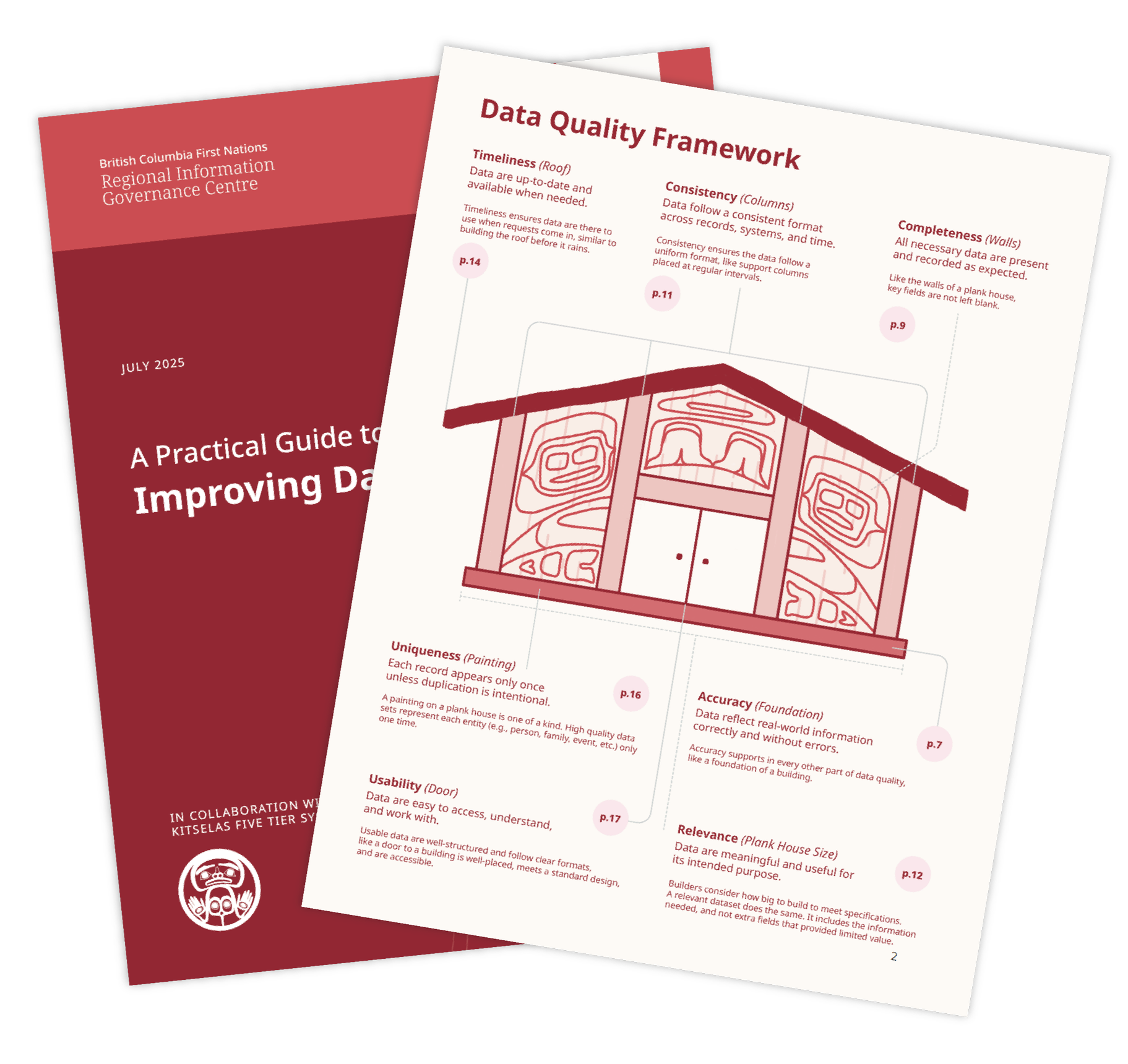
Through this project partnership, the BC RIGC and K5T co-developed a Data Quality Guide that outlines a practical framework designed for First Nations governments and organizations also looking to improve their data holdings.
Data Quality Guide
It focuses on ensuring data are fit for use across seven elements: accuracy, completeness, consistency, relevance, timeliness, uniqueness, and usability.
If this work resonates with your organization, we invite you to explore the guide or connect with us to continue the conversation.