Part one in the “Learning by Doing” series
The question we hear most often from Nations working on data governance is,“where do we start?”
This question is common because data governance work isn’t linear. It is highly interconnected, involving policies, people, infrastructure, relationships with other governments, and the daily practice of using information to plan and decide.
It is also a common question because governance systems are never “finished”, instead their component parts are always evolving and strengthening based on emerging needs, evaluations, and other information.
These truths are evident from the data governance framework below. This visual was developed by Indigenous governments across the country. It is circular, with layers nesting and relating to one another. There is no clear “entry” and it is always in motion. This is why many Nations seeking to build their data capacity are unclear where best to start with that journey – what aspect of the framework should they start with, why, and what steps should they take?
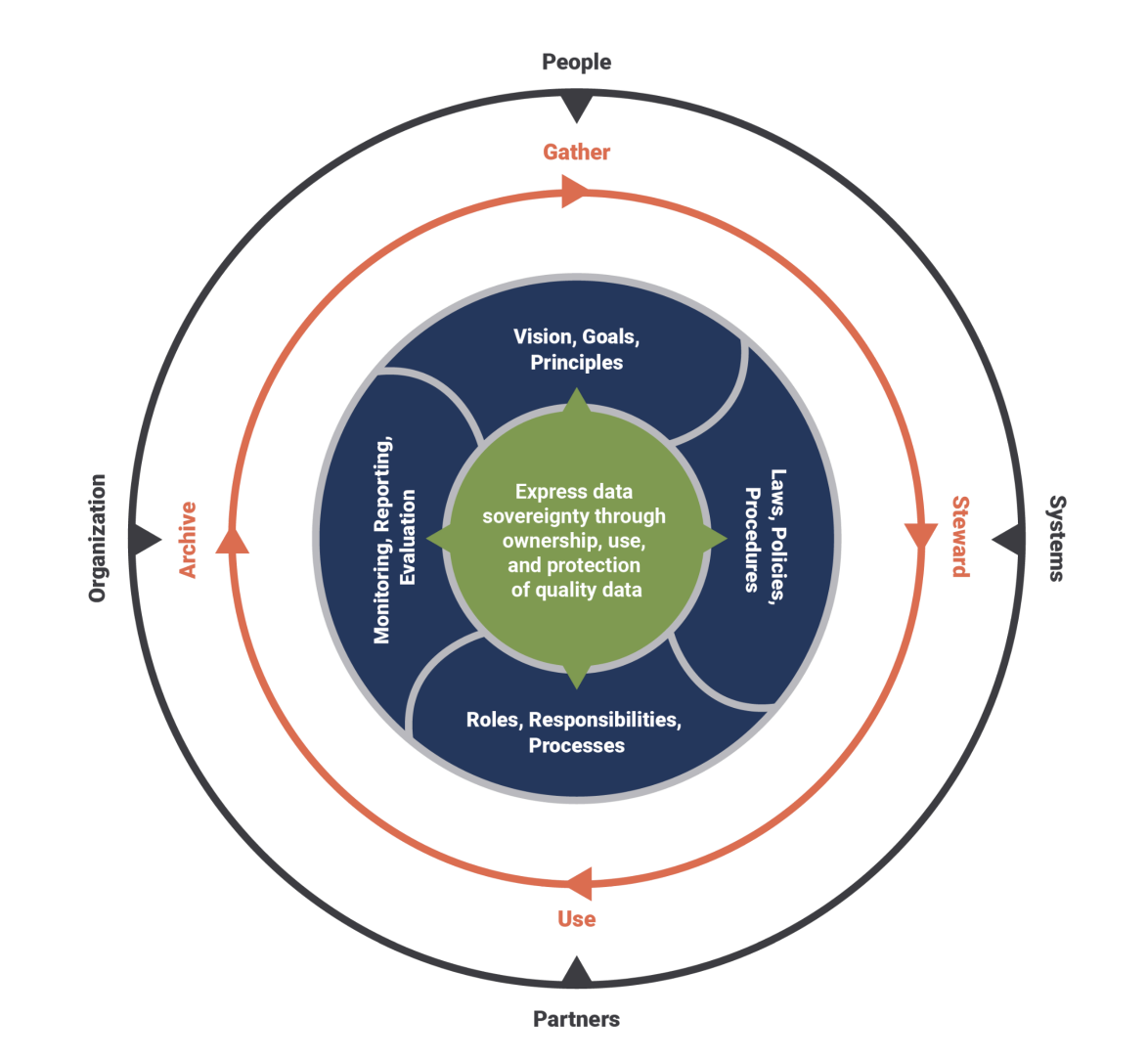
Supporting Nations to answer that question in practical and cost-effective ways is why the BC RIGC built the Data Governance Assessment. Using the above data governance framework, the Assessment provides a structured mechanism for any Nation to take stock of their current capacity across five data dimensions:
Data Governance: the way decisions are made about data
Organizational Culture: how data are valued and integrated into day-to-day administration
People and Partners: the roles, expertise, and relationships that carry out data work
Data Use: the ability to collect, analyze, and apply data to decisions
Tools and IT Systems: the technology that stores, connects, and secures data across the organization
The process involves working through a standard questionnaire using the BC RIGC’s user-friendly platform. The questionnaire can be filled out on behalf of an individual, a team or department, or an organization overall. Multiple Nations can also work together in taking the assessment if they plan to collaborate on the results.
Those results are provided instantly, with the ability to compare to the average score for all respondents. The tool also provides support to generate an action plan based on the assessment results, a Nation’s priorities, and available resources. Tools, guides, and templates to support the action plan’s implementation are also provided.
No one has a perfect data governance system and each Nation is unique. This assessment helps grow data capacity from a Nation’s current starting point. The collective results also support the BC RIGC to design its programs, services, and supports to best align with the common capacity needs of First Nations in BC.

What 58 Nations Are Showing Us
To date, 58 First Nation organizations in BC have completed the Assessment, representing more than one in four Nations in the province and a range of community sizes, geographies, and governance structures. This makes the assessment one of the most substantial cross-sectional snapshots of data and digital governance capacity among First Nations governments in BC to date.
There are very clear patterns in the results.
The greatest strength, by a wide margin, is Organizational Culture, at 66%. Leadership recognizes the importance of data. Internal openness to strengthening data systems is present. Administrative and political readiness exists.
The two lowest-scoring domains are deeply intertwined, and which require the most sustained investment to build a: Tools and IT Systems at 24% and Data Governance at 23%. First Nations have been chronically underfunded for their core needs in data and associated tools – as such, they are earlier in the journey of establishing both the decision-making and supporting technical infrastructure common to other governments and organizations.
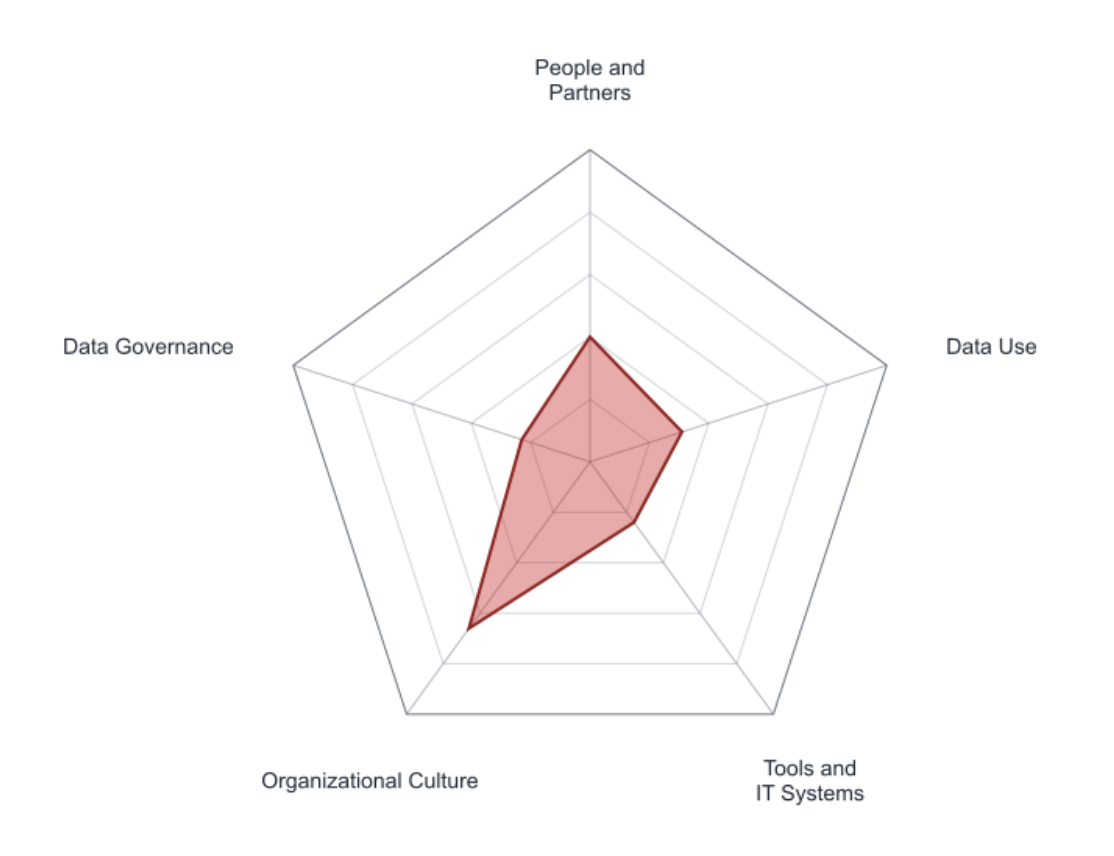
Organizational culture and readiness exist to make data capacity growth a reality. Assessment results clearly reveal the need for shared tools and approaches in data governance and digital infrastructure, which require personnel and partnerships that collectively make data use possible.
A Closer Look: Okanagan Nation Alliance
In the summer of 2024, the Okanagan Nation Alliance (ONA) completed the Data Governance Assessment with 17 senior staff across Administration, Wellness, Fisheries, and Natural Resources. The process confirmed something ONA leadership had observed for years. Departments had been working largely in silos, with differing levels of investment in data governance and without a unified organizational approach. The Assessment gave ONA a shared way to articulate the gap and move from reflection into planning.
From those findings, ONA developed a Data Strategy roadmap that is now guiding further employee and Nation engagement. ONA has secured BC RIGC funding to develop this strategy and develop syilx data principles, grounded in nsyilxcən (syilx language), sqəlxʷɯcawtət (syilx ways), and captikʷɯ (stories that describe syilx laws, responsibilities, songs, ceremonies, and ways).
““The BC RIGC data needs assessment tool assisted ONA in getting a thorough understanding on the current data needs in the organization. From that an ONA data strategy roadmap was developed and further employee and Nation engagement was sought. Most of the feedback has been positive and ONA staff feel a sense of relief that this work is done, as the need is so high.””
What Are We Doing With the Results?
When Nation after Nation names the same priorities, our direction becomes clear.
The BC RIGC has developed a shared digital infrastructure platform, the Build Your Own Data Centre (BYODC). This BYODC houses the Data Governance Assessment itself, as well as a growing set of tools, templates, and guides in the five domains of the Data Governance Framework. These resources are tested through on-the-ground practice with First Nations, collectively building the knowledge and wisdom to help one another on this ongoing data capacity journey.
These results also help the BC RIGC to learn, grow, and provide better services to First Nations. This post has described the most common areas of data capacity needs that sharpen the BC RIGC’s focus – the “what” of our work. In future posts in this blog series, we’ll dig more into what we’re learning about the “how” of our work, including how to best set up new projects for success, and the key challenges and drives of success we see from completed demonstration projects.
Where Do We Start?
For any Nation interested in utilizing the Assessment, the BC RIGC is available to work shoulder-to-shoulder to work through the tool and develop and implement an action plan. That may include facilitation of workshops, advisory support on data governance planning, and developing data capacity projects that advance a Nation’s action plan priorities. Some examples:
Develop data governance policies and procedures
Undertake a data collection project
Onboard staff to the BYODC to provide new digital tools for data archiving, management, and use
Develop and measure indicators
If your Nation is ready to find its starting point by using the Assessment, we invite you to connect with us. We’ll send you a link to the online tool and offer support along the way.