
Publication Library
BC RIGC creates publications grounded in real governance contexts and are intended to support Nations implementing data governance systems. They also contribute to broader conversations about Indigenous data sovereignty, digital infrastructure, and Nation rebuilding.
Featured Pieces
Valuation Tool
First Nations often need to seek compensation and recognition for losses in value, and for infringements on rights and title, resulting from Crown actions and decisions. The Valuation Tool consolidates practical guidance on compensation valuation to support informed, confident, Nation-led decision-making on valuation approaches.
The Guide includes context on the policy and legal landscape, background on value and valuation, a methodology guide, and hypothetical scenarios. This Guide overview highlights the steps a Nation would take to start and carry out valuation work.
Data Quality Guide
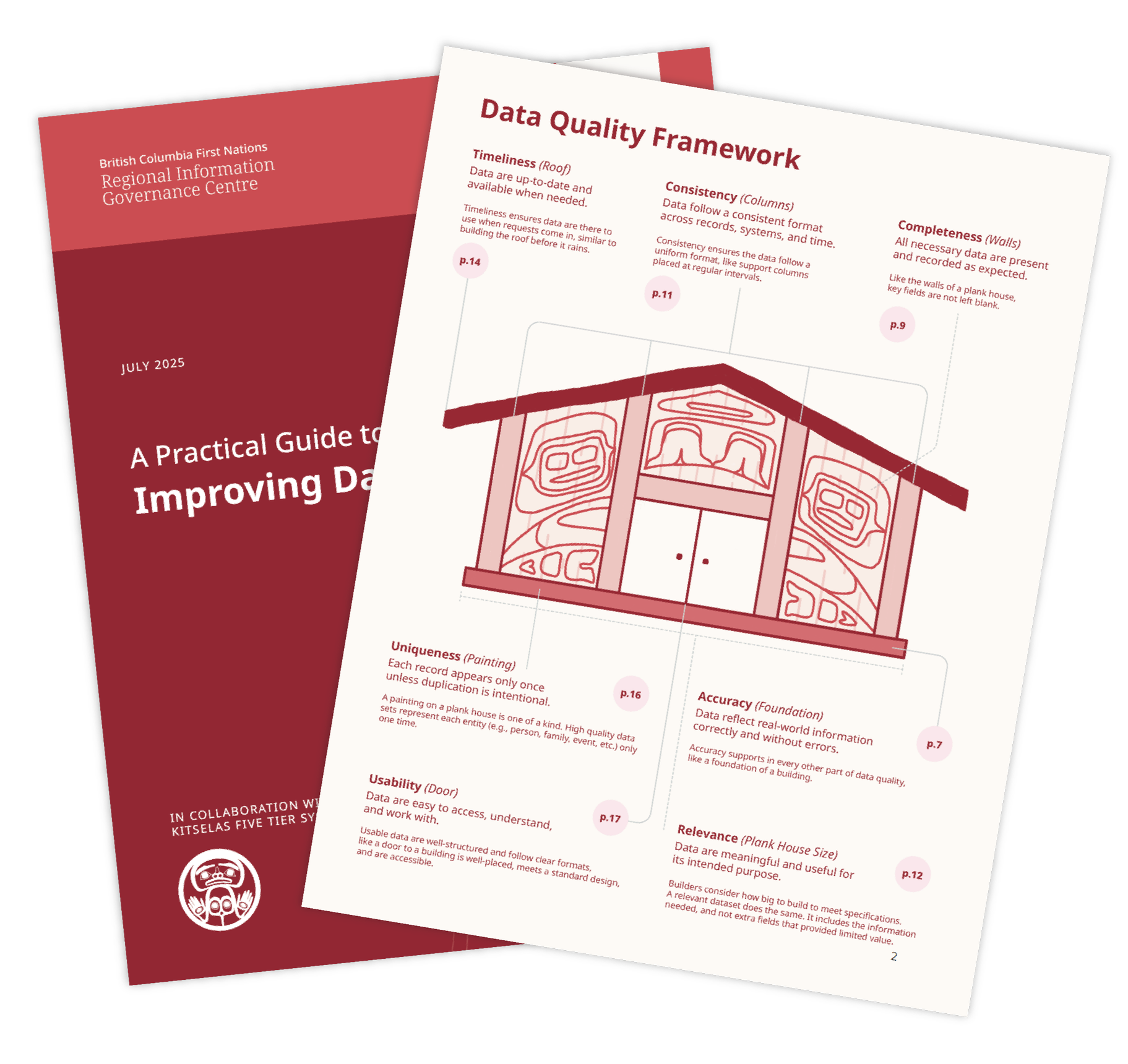
For First Nations people, data are a powerful tool that helps tell our stories in a meaningful way. Data quality refers to how “fit for use” data are – in other words, can you trust the information to be accurate, useful, and timely for your needs? Strong, high-quality data build confidence, support advocacy, improve program delivery and planning, and inform decision making to ensure resources are directed where they will have the greatest impact.
Kitselas Five Tier and the BC RIGC collaborated to create a Data Quality Guide for other Nations to use when considering data collection.
IPCA Costing Tool & Companion Guide
Indigenous Protected and Conserved Areas (IPCAs) require long-term financial planning to support establishment, operations, stewardship, and enforcement. The IPCA Costing Tool was developed to help Nations estimate costs, explore revenue options, and model different scenarios and time horizons as planning evolves. Built around flexibility, modularity, and transparency, the tool allows users to adjust cost and revenue components and assess long-term financial sustainability.
Tsleil-Waututh Nation and the BC RIGC collaborated to create the IPCA Costing Tool as a generalizable product for other Nations considering similar work.
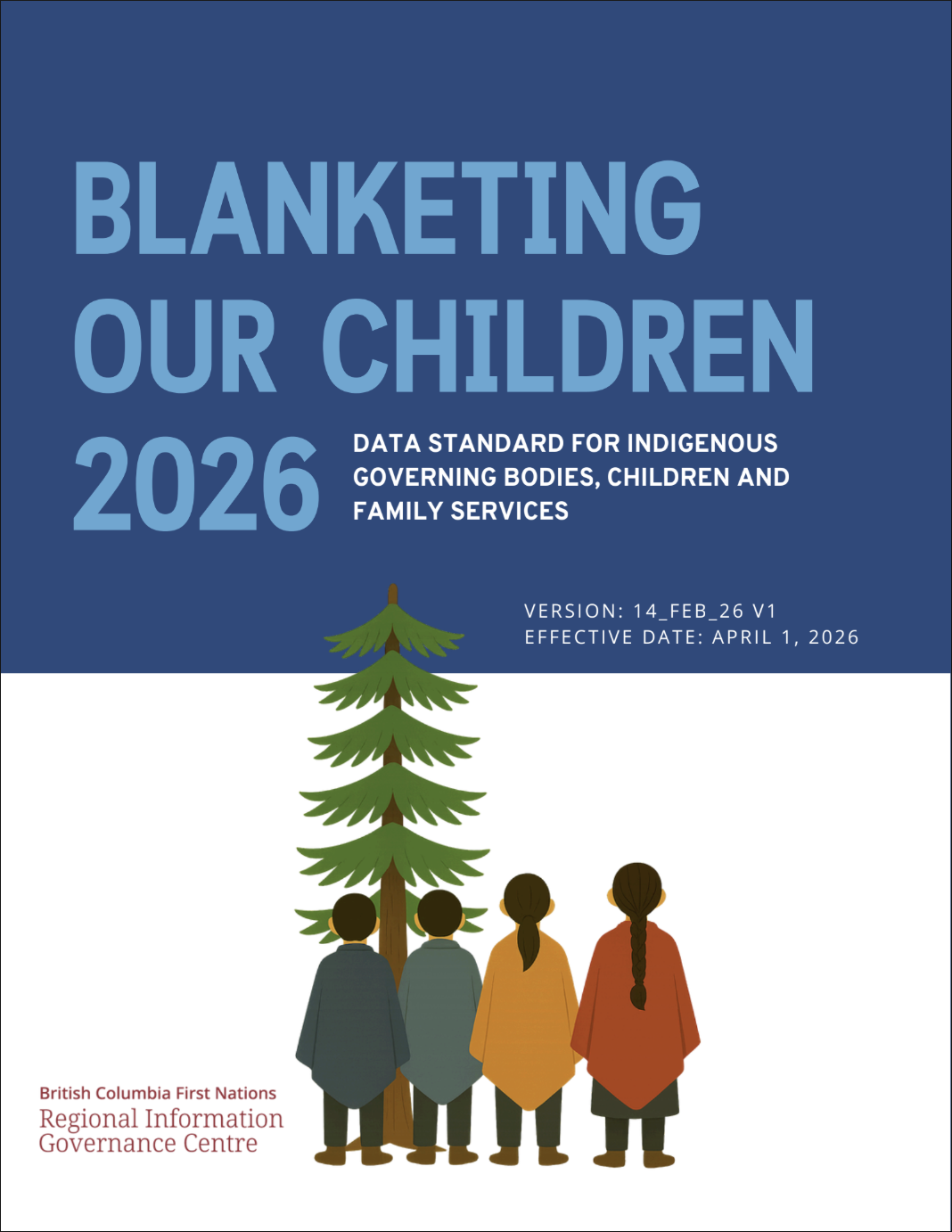
Blanketing our Children Data Standard
As Indigenous Governing Bodies resume jurisdiction over child and family services, they need data systems that reflect their laws, values, and service delivery models while supporting safe information sharing. The Blanketing Our Children Data Standard provides a shared foundation for defining, collecting, managing, and sharing child and family services data. It includes common definitions, data elements, and practical scenarios that can be adapted to each Indigenous Governing Body’s context.
The South Island Indigenous Authority, a Working Group of Indigenous Governing Bodies from across BC, and the BC RIGC collaborated to develop the Data Standard as a living tool.
Case Studies
Advancing K5T’s Data Management & Sovereignty
Kitselas Five Tier System (K5T) improved its Community-Based Reporting Tool to strengthen how employment, education, and skills training data are tracked and reported. The project focused on updating the tool, streamlining reporting requirements, and improving staff training. This resulted in more consistent use of the system, better data quality, and clearer information for leadership decision-making.
The Economic Impact of Nisg̱a’a Lisims Government
Nisga’a Lisims Government (NLG) developed a custom economic model to measure the Nation’s direct, indirect, and induced impacts. The model tracks indicators such as GDP, employment, labour income, and tax contributions. This provides evidence to support negotiations, policy development, and long-term planning.
IPCA Financial Feasibility and Costing Tool
Declaring an Indigenous Protected and Conserved Area (IPCA) is an act of self-determination and assertion of governance over territorial lands and waters. An IPCA is a permanent operational commitment that requires sustainable finances to support establishment and indefinite operation, stewardship, and enforcement. To inform its decision whether or not to pursue an IPCA, and under what conditions, Tsleil-Waututh Nation (TWN) developed a costing tool to understand what it would cost to establish and manage an IPCA in TWN territory and how it could be funded over decades.
Lands & Resources Data Management
The Council of the Haida Nation (CHN) is strengthening the policies, roles, and practices needed to manage lands and resources data across the organization. This case study outlines how the CHN developed practical foundations for data management in support of governance, including internal capacity, policy development, and day-to-day implementation. It offers useful lessons for other Nations working to organize existing data and build stronger systems for decision-making over time.
GeoDatabase Development
Seabird Island First Nation developed new aerial imagery, an orthomap, and elevation models to support future geospatial data management. This case study outlines how Seabird Island built a geospatial foundation for planning, infrastructure management, and future Geodatabase development, while strengthening internal data capacity. It offers useful lessons for other Nations beginning similar work to build community-controlled spatial data systems over time.
Blanketing our Children Data Standard
The South Island Indigenous Authority (SIIA) led the Blanketing Our Children initiative with 15 Indigenous Governing Bodies from across BC. Together, they developed a Child and Family Data Standard to support safe information sharing while allowing each Indigenous Governing Body to reflect its own laws, values, and service delivery model.